What Is the Easiest Way to Explain “History vs Fantasy” in Viking Media?
The easiest way to explain history versus fantasy in Viking media is not to sort every detail into “true” or “false”. It is to ask what job the detail is doing. Is it supported by archaeology or written evidence? Does it belong to a mythological story? Or is it a visual shortcut that helps an audience recognise “Viking” in a second?
That gives us three useful categories: the archaeology evidence bucket, the mythology story bucket and the design shortcut bucket. A single film, series or game can use all three at once. A round shield might be grounded in historical finds; a god appearing in a dream belongs to mythic storytelling; a horned helmet is usually a design shortcut, not a reliable reconstruction.
This approach is more useful than calling a whole production “accurate” or “inaccurate”. Viking-age societies existed across a long period and a wide region, and the surviving evidence is uneven. Meanwhile, storytellers need to establish a world quickly and make it emotionally legible. The trick is to notice which bucket a detail belongs in—and whether the story is asking us to mistake one bucket for another.
The three buckets: a quick guide
Bucket What it contains A Viking-media example Archaeology evidence Objects, buildings, burials and other physical evidence, interpreted with care A metal helmet, a ship burial, or evidence of a settlement Mythology story Gods, supernatural beings, legendary events and beliefs represented in stories Odin, Thor, prophecy or a journey into a mythic realm Design shortcut A familiar visual cue used to communicate a setting fast A horned helmet, a wall of shields, or a snowbound fjordThe buckets are not quality rankings. Fantasy is not automatically a mistake, and archaeology is not a complete script. The categories help us describe what a production is doing. A scene can draw on historical objects and still invent its characters, dialogue and plot. A myth-based story can be culturally thoughtful without pretending to be a documentary.
How the visual vocabulary says “Viking”
Media has a compact visual vocabulary for Vikings. Ships, shields and settlements tend to do the most work. They are instantly recognisable, easy to frame, and full of storytelling potential: a ship suggests travel or invasion; a shield wall suggests danger; a settlement suggests a community with something to lose.
Ships: more than a longship silhouette
Viking-age Scandinavians built vessels suited to different purposes. The long, relatively shallow-draught ships familiar from screen images could travel along coasts and rivers, while other ships were better suited to carrying cargo. I've seen this play out countless times: wished they had known this beforehand.. The clinker-built construction—overlapping planks fastened together—is part of what made Norse ships distinctive.
On screen, though, one dramatic longship often stands in for all Viking maritime life. That is a design shortcut, but a useful one: it tells us quickly that characters can move between settlements and across water. A production becomes more historically textured when it suggests the variety behind the silhouette—trade, transport, fishing and migration, as well as raiding.
Shields: convincing, but not a uniform costume
Round wooden shields are another strong visual cue. A shield can be practical equipment, a bright patch of colour in a battle scene, or a symbol of group identity. Because paintings and game interfaces can show a line of shields at a glance, the “shield wall” is especially useful for establishing a conflict.
But matching shields, identical armour and perfectly coordinated ranks may say as much about a production’s design plan as about a particular historical force. Evidence does not give us a complete wardrobe catalogue for every community and every decade. When a screen army looks unusually uniform, we can put that neatness in the design shortcut bucket rather than assume that it is a precise reconstruction.
Settlements: not every Viking lived in a fortress
A settlement scene can quietly complicate the familiar image of the Viking as a raider. Houses, workshops, farms, trading places and harbours show people making a living and building local relationships. Archaeological sites can reveal the traces of domestic life and craft, although a modern reconstruction has to make choices where the evidence is incomplete.
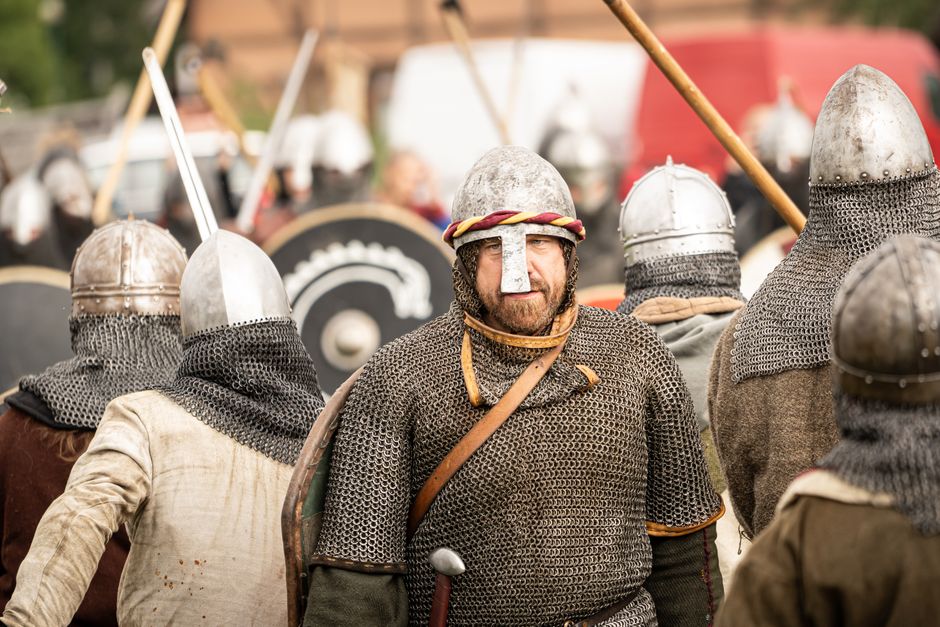
A settlement designed as a collection of dramatic timber halls may be visually effective, but it should not be treated as a universal template. If you want to assess a scene, ask what it shows people doing when they are not fighting. Everyday work is often a more revealing test of a setting than another battle montage.
Why games establish the setting faster than films
Films and television can build a setting through pacing: a shot of a ship at sea, a conversation in a hall, a character’s reaction to a strange ritual. The audience has time to infer what kind of world it has entered. A game faces a different problem. Players may need to understand the setting, the controls, the objective and the danger almost immediately.
That makes games particularly fond of readable visual signals. A longship on the horizon can mark the world as Norse-inspired. A shield emblem can identify a faction. A carved rune, a snowy mountain or a horned helmet can do the work of a paragraph of exposition. This is not inherently a flaw. Games need to communicate while the player is moving, choosing and paying attention to other things.
Film has its own shortcuts, of course. A single establishing shot can place us in a harbour settlement; a costume detail can announce a character’s status; a musical cue can make a landscape feel mythic. But a film can linger on ambiguity, while a game often needs the player to know where to go and what to do. The difference is not that games are less historical. It is that their storytelling has to compete with interaction.
That is why a historically informed game may still use simplified designs. The useful question is whether the shortcut is just an entry point, or whether it becomes the whole picture. Does the game offer variety and context as it unfolds? Or does every Norse character remain a bundle of the same visual signals?
The horned helmet myth—and why it sticks around
The horned Viking helmet is one of the clearest examples of the design shortcut bucket being mistaken for the archaeology evidence bucket. Horns make a character readable from a distance. They create an imposing silhouette, work well in illustrations and costume design, and instantly tell an audience, “This is a Viking.” Their familiarity is the reason they persist—not evidence that Viking warriors generally wore them.
There is no good archaeological basis for treating horned helmets as standard Viking-age battle gear. The image owes much to later artistic and theatrical traditions, especially nineteenth-century romantic depictions of the Norse past. Costume design and popular illustration helped turn the idea into a recognisable convention. Once repeated often enough, a visual invention can feel like a memory of history.
There is also a practical point. Protruding horns would be awkward in combat: they could catch, snag or interfere with movement. That does not prove what every individual ever wore, but it is another reason to be cautious about treating the familiar costume as battlefield equipment.
When the horns appear in a comedy, a fantasy game or an intentionally over-the-top adventure, there may be no problem at all. They are a signal. The confusion starts when the same image is presented as straightforward historical fact. A quick test is to ask: is the story using the horns to evoke a popular idea of Vikings, or does it claim that the image is archaeologically supported?
The Gjermundbu helmet: a reality check
The Gjermundbu helmet offers a useful counter-image. Found in a tenth-century burial in Norway, it is the best-known near-complete Viking-age helmet discovered in Scandinavia. Its surviving form is very different from the horned helmet of popular imagination: it has an iron cap and a distinctive face protection often described as a spectacle guard.
It is important not to overclaim what one find can tell mrq mobile slots us. The Gjermundbu helmet does not prove that every Viking wore the same design, or that helmets were common among all people who fought. Surviving objects are only part of the picture, and burial evidence reflects particular choices and circumstances. But it gives us a concrete object to compare with the screen stereotype—and there are no theatrical horns on it.
That makes it an excellent “reality check” for viewers. Instead of asking whether a production has copied this one helmet exactly, ask whether it distinguishes evidence from convention. A designer may choose a fantasy helmet for style. A documentary or a historical drama claiming close material accuracy has a stronger reason to consider what actual finds look like.

A simple way to explain it to someone watching
If a friend texts, “Did Vikings really do that?”, try this three-step answer:
- Name the bucket. Is the detail supported by an object or site, drawn from mythology, or used as a visual shortcut?
- Give the evidence in proportion. Say what a find can show, but also what it cannot establish for every Viking community or period.
- Separate accuracy from storytelling. A production can deliberately invent something. The key is whether it presents that invention as fantasy, tradition or historical fact.
For instance: “Round shields fit the broad material picture, although this scene’s identical designs are probably a visual choice. The horned helmet is a familiar modern convention, not a good representation of Viking-age helmets. The gods belong to the mythology story bucket, which is a different kind of truth from an excavated object.”
This method works whether you are watching a film, playing a game or reading a history feature. It also keeps the conversation friendly. Exactly.. Instead of treating every fantasy element as an error, you can explain how the image works—and where the evidence points in another direction.
Enjoy the story, keep the categories clear
Viking media becomes easier to discuss when we stop asking whether it is simply “real” or “fake”. Ships, shields and settlements form a visual vocabulary that helps establish a world. Games often deploy that vocabulary quickly because players need immediate orientation; films can take more time, but they use shortcuts too. Mythology adds affiliate link disclosure another layer, while archaeological finds offer material evidence that is fascinating but never complete.
That distinction is useful for writers and audiences alike. A feature from HistoryMedieval, or Viking imagery encountered through entertainment brands such as Mr Q or MrQ, may invite different expectations depending on its format and purpose. Whatever you are reading or playing, look for the signal: is the piece offering evidence, telling a mythic story, or using a familiar design cue?
If you want to keep a handy version of the explanation, use the Print Article option—the PDF/print function—to save it for later. Or use the Facebook share option to send it to the friend who has just spotted a horned helmet and wants to know whether it is history or fantasy.